Quick Summary
A hamon is the visible line where a katana's hard edge meets its softer spine.
The hamon forms during clay tempering. A smith coats the blade in clay, heats it, and quenches it in water, which hardens the thin-coated edge and leaves the thicker-coated spine tougher. The hamon is the boundary between the two zones. It can be straight or wavy, and a real hamon shows tiny crystal details called nie and nioi. Many replicas use an etched hamon instead.
If you have ever looked at a katana and noticed a wavy, cloudy line running along the edge, you were looking at the hamon. It is one of the first things collectors check, and it is also one of the most misunderstood parts of a Japanese sword.
This guide explains what a hamon is, how clay tempering creates it, what the main hamon patterns look like, and how to tell a real one from an etched copy. By the end, you will know what the temper line really means.
What is a hamon on a katana?
A hamon is the visible line that runs along the edge of a Japanese sword, where the hardened steel of the cutting edge meets the softer steel of the spine. The word means "edge pattern," and the hamon is the most recognizable feature on a traditionally made katana. Smiths and collectors have admired it for centuries.
The hamon is not painted on or carved in. It shows up because of how the blade was heat treated, and a polisher brings it out with Japanese stones. That is why a real katana hamon looks like a faint cloud or ridge line under the steel, not a flat gray stripe.
The yakiba and the edge
The hardened zone that holds the cutting edge is called the yakiba. The hamon is the border of that zone. Everything between the hamon and the edge is hard steel, and everything on the other side is softer and tougher.
Where the hamon came from
The hamon grew out of ironmaking that reached Japan around 600 to 700 AD. Chinese swords often joined a hard edge to a soft back, and Japanese smiths adapted that idea into their own differential hardening. A smith named Amakuni Yasutsuna is credited with the process around the 8th century, though the true inventor cannot be identified and the story is partly legend.
How does clay tempering create a hamon?
A smith coats the finished blade in a clay mixture before heating it. The clay is thin over the edge and thicker over the spine and body. Then the blade is heated until it glows and plunged into water, a step the smith calls yaki-ire.
Because the clay slows cooling, the thick areas cool gently and the thin edge cools fast. The fast-cooled edge turns into martensite, a very hard structure. The slow-cooled spine forms pearlite, which is softer and absorbs shock. The hamon forms right where those two zones meet.
One source gives example hardness numbers of about 40 HRC at the spine and about 58 HRC at the edge. Another puts the edge anywhere from 50 to 62 HRC and the spine between 38 and 45 HRC. Either way, the pattern of the hamon is the proof that the blade was hardened in two different ways.
2 zones
A clay-tempered blade has a hard martensite edge and a tougher pearlite spine, and the hamon marks the border between them.
What goes into the clay
The traditional clay is a blend of clay, polishing stone powder, and charcoal powder. Every smith has a personal recipe, and schools once kept their blends secret. The coat is kept thin enough to prevent cracking, and it stays back from the edge by roughly a centimeter (about 0.4 inch). The clay must dry fully, which can take hours or even a day or two. If it is still damp, it bubbles and flakes in the fire.
Why the blade curves
The uneven cooling also explains the gentle curve of the blade. The spine cools more slowly than the edge, so the sword bends as it is quenched. For a deeper look at how a curved blade differs from other long swords, see this guide to tachi vs katana.
What are the main hamon patterns?
Hamon patterns fall into two big families. Suguha is a straight, even line that runs parallel to the edge. Midare is the irregular family, and it covers waves, teeth, and clove shapes. A single blade can mix the two, so a smith might set a straight hamon near the handle and a lively one toward the tip.
Suguha is the most common style across eras, and its width varies from string-thin to wide. Midare patterns were more artistic and historically tied to wealthy patrons. Irregular hamon patterns became common from around the 1300s, according to one history of the subject.
| Pattern | Look | Quick note |
|---|---|---|
| Suguha | Straight, even line | The most common style. Width ranges from very narrow to wide. |
| Gunome | Rounded or tooth-like waves | A repeating zig-zag. Small versions are called ko-gunome. |
| Notare | Large, flowing waves | A billowing line with wide, gentle rises. |
| Choji | Clove-shaped bumps | Dates to the late Heian period. Overlapping versions are called juka choji. |
| Sanbon-sugi | Repeating peaks like cedar trees | Linked to the smith Magoroku Kanemoto and called three cedars. |
| Togari gunome | Orderly, pointed peaks | Found mainly on swords from the Sue-Seki school. |
Not every hamon fits neatly into one box. Smiths blended styles, and many schools had signature shapes that experts can recognize on sight. Later on, pictorial hamon patterns appeared, and by the 17th century trees, flowers, and clover shapes were common.
What are nie and nioi inside the hamon?
Nie and nioi are the tiny crystal details inside the hamon, and they are what separate a real hamon from a cosmetic one. Nie are bright, wispy flecks that look like frost or stars along the line. Nioi is a softer, misty band a few millimeters wide that follows the border.
Nioi is the true boundary between martensite and pearlite. It is hard to see in direct light and shows best when you tilt the blade at a grazing angle. Under magnification it looks like a sparkly line of bright grains surrounded by darker steel. One reference notes that nioi cannot be faked by etching.
A real hamon is not just a pattern on the surface. It is the visible edge of a hardening process that changed the steel itself.
A real hamon is not just a pattern on the surface. It is the visible edge of a hardening process that changed the steel itself. That is also why the hamon runs through the full cross-section of the blade and not only the polished face.
Does a hamon make a katana better?
A real hamon tells you the blade was differentially hardened, and that brings real benefits. The hard edge can take a finer sharpening and hold it longer, while the softer spine helps absorb shock. Sellers who specialize in Japanese-style swords often point to this combination as the reason the design lasted so long.
That said, a hamon does not automatically mean a blade is excellent. It is evidence of skill and time, not a quality guarantee. The quench is the riskiest step, and a blade that makes a pinging sound has failed. Failure rates add cost, which is why swords with a real hamon usually cost more than uniformly hardened ones.
Differential hardening also has one trade-off. A blade bent sideways tends to stay bent instead of springing back. It can usually be straightened, though repeated bending may weaken the steel. For a look at how steel choice changes the story, read this comparison of 1095 high carbon and Damascus steel.
How can you tell a real hamon from an etched one?
Plenty of mass-produced swords carry an etched hamon, which is a temper line that was added to the surface for looks. Makers create it by polishing the hamon area in a different direction, or by using acid or sandblasting. The blade itself is usually one uniform hardness all the way through.
- Look for nioi and nie. A real hamon has a soft misty band and bright flecks. An etched line often has a hard, flat border with no gradation.
- Check for unnatural regularity. A hamon that repeats the exact same shape over and over, with no variation, is a warning sign.
- Tilt the blade under diffuse light. A real hamon changes as the angle changes. Direct sunlight causes glare that hides the detail, so use soft light and a 10x loupe if you have one.
- Read the product description. Honest sellers say whether a blade is clay tempered, uniformly hardened with an etched line, or purely decorative.
- Test the hardness. The only reliable proof is to compare hardness at the edge and at the spine. If the numbers match, the hamon is not real.
Polish alone is not a trustworthy test. A real hamon can be hidden by poor polishing, and skilled polishers sometimes use light etching to reveal it. If you are shopping for a replica, treat the hamon as a design feature unless the seller states that the blade was differentially hardened. Browse the full range of replica katanas and read each description closely.
What is the difference between a hamon and a Western temper line?
A Western temper line looks similar but forms differently. It can come from a partial quench, flame hardening, or differential tempering. Flame hardening creates a heat-affected zone that is brittle and lacks nioi, so it is rarely used on swords that face heavy impact.
That means a straight line on a Western blade is not automatically a katana hamon. A Japanese-style hamon comes from the clay, the single quench, and the steel structure that results. If you want to learn how blades fare on a wall or shelf, our guide on high carbon steel vs stainless steel katanas covers the material side.
How do you care for a blade with a hamon?
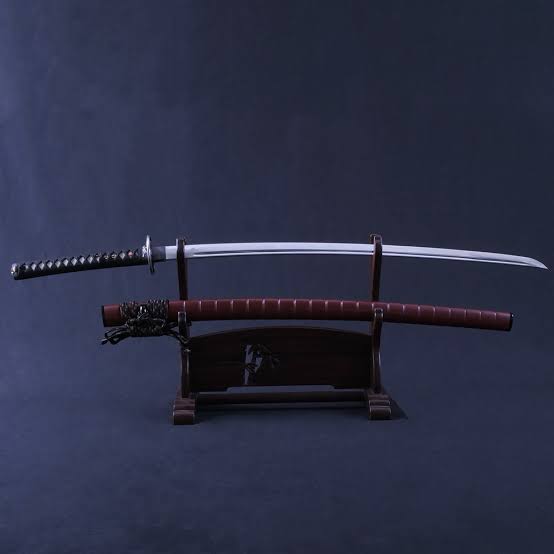
Caring for a hamon is the same as caring for the blade. Keep the sword in a cool, dry place away from sunlight and humidity, and use a wooden or lacquered stand because bare metal can scratch the steel. Hold the sword by the handle and avoid touching the blade with bare hands.
Wipe the blade with a soft cloth or uchiko powder, moving from the handle toward the tip, and add a thin coat of oil. Avoid abrasives and harsh chemicals, and never try to polish a hamon yourself. A professional polisher, called a togishi, does that work. Our step-by-step guide on how to clean and maintain a metal katana walks through the routine.
A katana hamon is proof of process, not just decoration
The hamon is the visible record of clay, fire, and water. It tells you where the hard edge ends and the tough spine begins, and it gives each blade its own look. Learn the main hamon patterns, check for nioi and nie, and you will read a katana the way a collector does.
Frequently Asked Questions
What does the hamon do on a katana?
The hamon marks where the hardened edge meets the softer spine on a differentially hardened blade. The hard edge holds a sharp line, and the softer spine absorbs shock. The visible pattern is a result of that process, though smiths also treat it as art.
Is every hamon on a katana real?
No. Many mass-produced swords carry an etched or polished hamon that was added only for looks. A real hamon shows nioi and nie and comes from clay tempering, so check the product description and look closely under diffuse light.
What is the most common hamon pattern?
Suguha, the straight hamon, is the most common style across eras and regions. Midare, the irregular family that includes gunome, notare, and choji, is the main alternative. Smiths also combined the two on one blade.
Can a hamon be fixed or restored?
A hamon can fade or be hidden by wear, rust, or a poor polish, and a trained polisher called a togishi can bring it back. Do not polish it yourself, because abrasives can damage the steel and the details inside the hamon.
How should you display a katana with a hamon?
Use a wooden or lacquered stand in a cool, dry room away from direct sun. Soft, indirect light shows the hamon best. Keep the blade lightly oiled and avoid humid spots like basements and attics.
Do beginners need a real hamon?
No. A beginner can enjoy a replica katana without a differentially hardened blade, and an etched hamon is fine for display or cosplay when the seller is honest about it. A real hamon matters more to collectors and to people who care about the heat treatment.
Do replica katanas come in different configurations?
Yes. Replica katanas vary in blade length, steel type, handle wrap, and scabbard style, and some are dull while others are sharp. Check the listing for the steel and the finish, and look at the dull and sharp options before you choose.
Find your next katana
Browse replica katanas and compare the blade finish, steel, and style that suit your collection.
Shop the CollectionSources
| Source | Article |
|---|---|
| Wikipedia | Hamon (swordsmithing) |
| Kult of Athena | An In-Depth Look at the Hamon |
| Sword Buyers Guide | Hamon |
| Japanese Sword | Explore the Beauty of Hamon on Japanese Swords: A Collector's Guide |
| TrueKatana | How does clay tempering create a real hamon line? |